Professional Tire
Replacement &
Repair Services
In Walnut Creek, CA
Summers in the East Bay and commutes through the Caldecott Tunnel can put immense strain on your vehicle's cooling system. Don't sweat the East Bay heat. From minor freon leaks to complex compressor failures, we diagnose and fix why your car's air conditioning isn't cooling.

Tire Replacement & Repair:
Frequently Asked Questions
Have A Question?
-
If your tread depth is low, your tires have uneven wear, or you notice cracks in the sidewalls, it's time to consider replacement. Most tires last between 40,000 and 70,000 miles.
-
Many punctures caused by nails or screws can be safely repaired if the damage is in the tread area. Sidewall damage or large punctures usually require tire replacement.
-
Most manufacturers recommend rotating tires every 5,000–7,500 miles. Regular rotations help extend tire life and promote even wear.
-
Vibrations at higher speeds are often caused by unbalanced tires, uneven tire wear, or alignment problems. A tire inspection can pinpoint the exact cause.
-
Uneven wear can result from improper inflation, poor alignment, suspension problems, or missed tire rotations.
-
Most tires last 4–6 years or between 40,000 and 70,000 miles, depending on driving conditions and maintenance.
It’s important to us that our customers know exactly what we’re going to do with their vehicle. Here’s what you can expect from Walnut Creek Brake and Tire when you bring your vehicle in for an Break Performance Check.
Tire Performance Check

A technician will use a digital gauge to measure the remaining tread at multiple points across each tire to ensure your vehicle has adequate traction and meets California's legal safety limits.
Tread Depth Inspection

The team will test and adjust the air pressure in all four tires—plus the spare—matching them exactly to your vehicle's factory specifications to prevent uneven edge wear.
Tire Pressure Check

The shop will inspect your tires for uneven shoulder wear and use precision diagnostic equipment to ensure your wheels roll smoothly and point straight down Walnut Creek's roads.
Wheel Balance & Alignment Review

Repair or Replacement Recommendations
Based on the physical condition of the rubber, our technicians will provide a transparent assessment detailing whether a simple puncture patch will suffice or if it is time to recommend a safe replacement tire.
Types of Tire Issues & Why They Matter
Because modern drivers frequently neglect to check their tire pressures until a dashboard warning light comes on, millions of vehicles are driving around on soft, under-inflated tires. How you maintain your air pressure directly dictates how the rubber contacts the road:
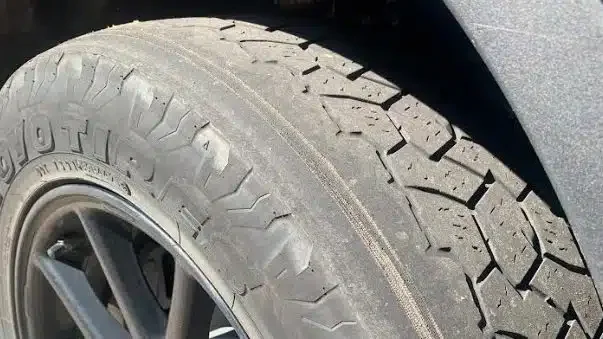
Underinflation (Both Outer Edges Worn): When a tire is low on air, the center of the tread collapses slightly inward. This forces the weight of the car onto the outside edges of the tire, causing the inner and outer edges to bald prematurely.
Overinflation (Center Tread Worn): Conversely, if a tire has too much air, it balloons in the middle. The center tread bulges out and takes the brunt of the vehicle’s weight, wearing down a smooth strip down the middle of the tire.
Uneven wear
Sidewall damage
Punctures
Dry rot and cracking
A Warning About Driving on Damaged Tires
Ignoring tire damage increases the risk of blowouts, poor handling, and reduced braking performance—especially during long commutes and summer heat.
Learn More About Our Automotive Services: